When Journalists Are Silenced Online, What Does Democracy Lose?
Online harassment is driving journalists out of the public conversation. The consequences extend far beyond the people targeted, threatening press freedom, independent reporting, and Canadians’ right to know.
Imagine spending weeks investigating a story that matters to Canadians. You interview sources, verify facts, challenge powerful interests, and prepare your findings for publication.
Then the story goes live.
Instead of debating what you’ve uncovered, many choose to fill your inbox with threats. Strangers circulate your personal information. Your credibility is attacked, your family becomes a target, and the conversation shifts from the facts you’ve reported to whether you deserve to speak at all.
Now imagine facing that possibility every time you publish.
At what point does telling the truth become too costly? What happens to democracy when journalists start asking themselves that question?
This is no longer hypothetical. Online harassment has become a serious threat to journalists around the world, including those working in democratic societies like Canada.
And while the abuse may happen on a screen, its consequences gowell beyond it.
The Hidden Cost of Online Harassment
Journalists have always faced criticism. Challenging powerful institutions, exposing wrongdoing, and asking difficult questions are fundamental parts of their work.
But there is a difference between holding journalists accountable and attempting to intimidate them into silence.
Legitimate criticism challenges reporting, evidence, and editorial decisions. Online harassment can involve threats of violence, coordinated abuse, the publication of private information, and campaigns intended to undermine a journalist’s credibility.
The distinction matters because the consequences are measurable.
Canada has already seen the consequences of this intimidation. In 2022, prominent Canadian media leaders called for action after sustained online harassment targeting journalists, including Rachel Gilmore. As J-Source reported in its investigation into online harassment in Canadian newsrooms, the problem has raised serious questions about whether news organizations and public institutions are doing enough to protect journalists.
According to a 2025 global study released by UNESCO and UN Women, 75% of the women journalists surveyed reported experiencing online violence in the course of their work.
Even more concerning, 42% of respondents reported online attacks connected to offline abuse, harassment, or assault, compared with 20% in the earlier 2020 survey. These findings reflect survey participants’ experiences, not all journalists, but they illustrate the problem’s seriousness.
The danger is not limited to what appears in a comment section. Online intimidation can follow journalists into their workplaces, homes, and everyday lives.
When harassment becomes an expected cost of journalism, the question is no longer simply how journalists can protect themselves. It is how society can protect the journalism it depends on.
When Fear Determines Which Stories Get Told
One of the most damaging consequences of online harassment is also one of the least visible: the stories that never get written.
A journalist who has experienced threats may think twice before covering another controversial issue. A reporter may withdraw from social media, avoid certain sources, or become less visible to protect themselves and their family.
These decisions can be entirely understandable responses to genuine risks.
But collectively, they can narrow the range of stories, perspectives, and experiences available to the public.
In its landmark study, The Chilling: A Global Study of Online Violence Against Women Journalists, the International Center for Journalists, working with UNESCO, documented the consequences of online abuse for women’s participation in journalism.
Among women journalists surveyed in the underlying research, 30% reported self-censoring on social media, while 20% said they had withdrawn from online interaction.
This phenomenon is known as the chilling effect: when intimidation discourages people from exercising their freedom to speak, report, or participate, even without a formal prohibition.
And the consequences are not evenly distributed.
Women journalists, particularly those reporting on gender, human rights, and politically contentious subjects, can face abuse designed not only to challenge their reporting but also to discredit them personally.
The consequences are already evident in Canada. According to a Canadian survey highlighted by News Media Canada, one in three participating journalists and media professionals had considered leaving the industry in the previous 12 months. The 2021 findings underscore an uncomfortable reality: when harassment drives journalists away, Canadians risk losing experienced voices and important reporting.
The danger is that public conversations become shaped not only by what is newsworthy but also by what journalists feel safe enough to investigate.
When intimidation influences which stories get pursued, the public loses information it may never know it was missing.
This Is Not Just a Problem for Journalists. It Is a Problem for Canadians.
Why should someone who has never worked in a newsroom care about online harassment of journalists?
Because journalism is one of the ways Canadians learn what governments are doing, how public money is being spent, whether institutions are serving their communities, and whose interests are influencing decisions that affect everyday life.
Independent reporting helps people make informed choices and hold powerful institutions accountable.
When journalists are intimidated, those democratic functions can be weakened.
Consider the consequences when reporters become reluctant to investigate controversial subjects, sources hesitate to speak publicly, or experienced journalists step away from visible roles.
Important perspectives may be lost. Scrutiny of powerful institutions may diminish. Public debate may become less informed.
The impact is especially troubling when harassment targets journalists covering communities or issues that already receive limited attention.
As Reporters Without Borders has documented, online harassment can be used deliberately to discredit journalists, overwhelm their reporting with misinformation, and intimidate them into silence.
The public has a stake in preventing that outcome.
Press freedom is not simply journalists’ right to publish. It is also Canadians’ right to receive information without intimidation determining what reaches them.
When Misinformation Becomes a Weapon Against Journalism
Online harassment rarely occurs in isolation.
It can intersect with misinformation and disinformation, especially when coordinated attacks aim to undermine trust in a journalist or their reporting.
False allegations can be repeatedly shared. Misleading clips can circulate without context. A journalist’s reputation can become the target of a campaign that has little to do with the accuracy of their work.
The result is a troubling reversal: instead of examining the evidence a journalist has presented, audiences are encouraged to question the journalist’s legitimacy.
Research by the International Center for Journalists found that 41% of women journalists surveyed reported experiencing online attacks that appeared connected to orchestrated disinformation campaigns.
The relationship between harassment and misinformation deserves particular attention because digital platforms are not neutral distribution systems.
Algorithms, recommendation systems, and engagement-driven business models shape what content people see.
Outrage, controversy, and emotionally charged claims can attract attention, whether or not they are accurate.
This creates a difficult environment for journalism, which depends on verification, context, and accountability.
A misleading claim may take seconds to create, while establishing the facts can require days or weeks of reporting.
The challenge is not simply that misinformation exists. The systems Canadians use to access information can make it easier for misleading or abusive content to gain attention.
Who Is Responsible for Protecting Journalists Online?
The responsibility cannot fall entirely on individual journalists.
Blocking abusive accounts, strengthening privacy settings, and reporting threats can help, but these measures alone cannot address coordinated harassment or the systems that enable harmful content to spread.
A meaningful response requires shared responsibility.
Digital platforms should provide effective reporting mechanisms, respond appropriately to credible threats, and be more transparent about how their systems amplify harmful content.
News organizations should establish clear protocols for supporting journalists facing online abuse, including safety assessments, access to professional support, and procedures for responding to serious threats.
Governments and policymakers should consider safeguards against threats, harassment, and other unlawful conduct while protecting freedom of expression and legitimate public debate.
The public also has a role in recognizing the difference between criticizing journalism and participating in campaigns designed to silence journalists.
These responsibilities are interconnected.
In Canada, the conversation about platform accountability is already underway.
As Friends of Canadian Media has previously explored in Media Mythbusters: Regulating Social Media Platforms Is Not Censorship, it’s important to distinguish between restricting lawful expression and holding platforms accountable for the systems that distribute and amplify harmful content.
That distinction should remain central to the debate.
Protecting people from threats and intimidation does not require eliminating disagreement, shielding journalists from scrutiny, or treating every offensive statement as unlawful.
The objective should be to create conditions in which robust debate can flourish without threats and harassment driving people out of public life.
A Safer Internet Should Not Mean a Quieter Democracy
Freedom of expression is essential to democracy. So is the ability to exercise that freedom without intimidation.
These principles should reinforce each other, not compete.
A healthy digital public sphere must allow people to challenge journalists, question institutions, express unpopular opinions, and engage in vigorous debate.
But it must also recognize that coordinated threats, harassment, and intimidation can undermine the very freedoms that open debate is meant to protect.
That is why online safety is not merely a question of content moderation.
It is a question of who gets to participate in public life, whose voices are heard, and whether Canadians can continue to rely on independent journalism to help them understand the world around them.
For Friends of Canadian Media, the stakes are clear.
Protecting independent journalism means more than defending news organizations or the people who work in them. It means defending the conditions that allow journalists to investigate, question, challenge, and report without fear of being silenced about what the public gets to know.
When a journalist is silenced, the loss doesn’t end with that journalist.
It extends to the communities whose stories may go untold, the institutions that may face less scrutiny, and the Canadians who depend on reliable information to participate meaningfully in democracy.
The question is not whether journalists should be free from criticism. They shouldn’t be.
The question is whether intimidation should decide who gets to report the news.
And in a democracy, the answer should be no.
Listen to the Conversation: Does the Digital Age Have to Be Dangerous?
What happens when journalists become targets simply for doing their jobs? And can we build a safer internet without sacrificing freedom of expression?
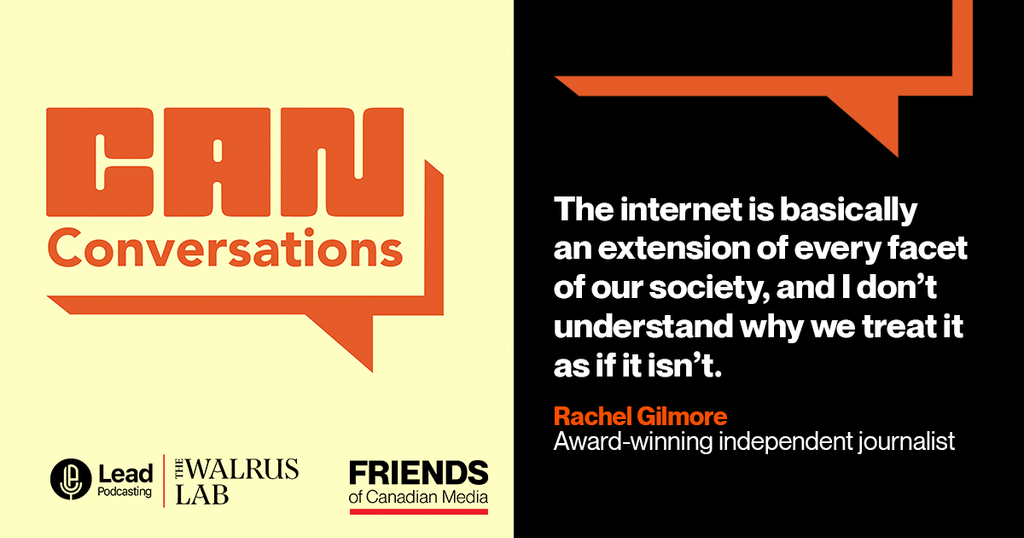
In this episode of CanConversations, host Raj Shoan speaks with award-winning independent journalist Rachel Gilmore about online harassment, misinformation, the influence of social media algorithms, and the responsibilities of technology companies.
Their conversation explores what is at stake for journalists, the public, and Canadian democracy.